
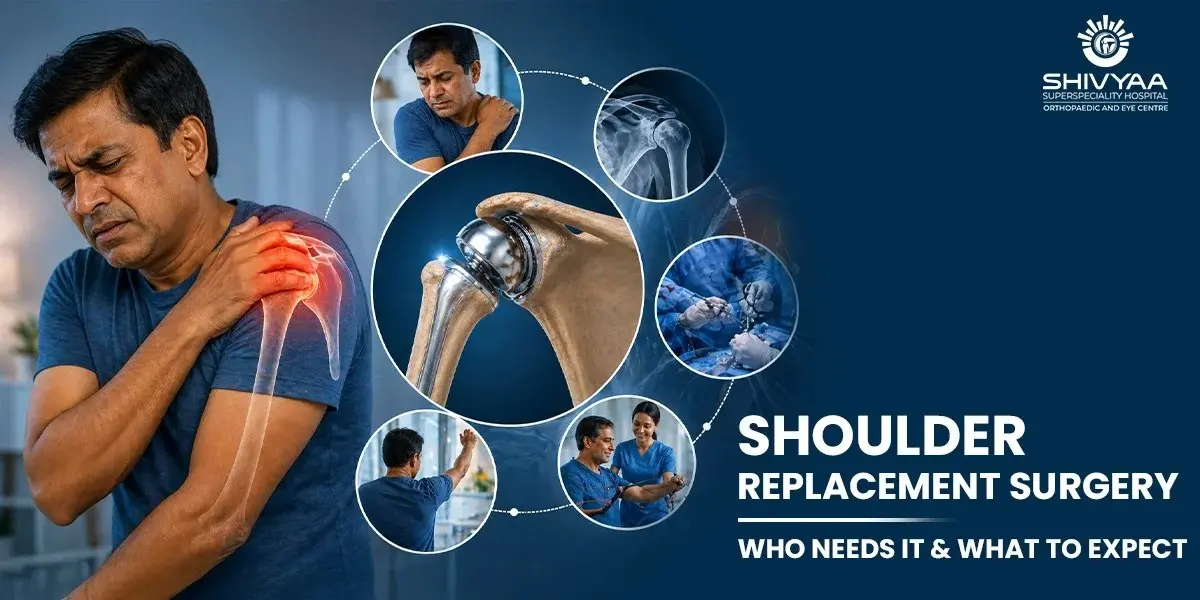
Some shoulder pain fades with rest. Some respond to physiotherapy or medication. But when arthritis, a severe fracture, or rotator cuff damage destroys the joint itself. No conservative treatment can reverse that.
Orthopedic surgeons recommend shoulder replacement surgery when the joint reaches that point. The surgeon removes the damaged bone and cartilage, replacing them with a precisely fitted prosthetic implant that restores movement and eliminates chronic pain.
The procedure demands careful evaluation. Surgeons consider it only after all other treatments fail. But for the right patient, it delivers results that nothing else can.
What is shoulder replacement surgery?
The shoulder is a ball-and-socket joint. The upper arm bone, the humerus, has a rounded head that fits into a socket in the shoulder blade known as the glenoid. In cases where disease or injury causes great destruction to either of these surfaces, the joint becomes incapable of functioning without pain.
Shoulder replacement surgery involves the replacement of the damaged bone surfaces with a metallic and plastic prosthetic implant. The surgeon removes the rotten bone and positions the implant in the exact position, which replaces the operations that the natural joint cannot perform.
The orthopedic surgeons also call the process “shoulder arthroplasty.” The aim is simple: to remove the pain and restore functional movement to the joint.
Types of Shoulder Replacement Surgery
All shoulder replacement surgeries are not done in a similar fashion. The type of surgery a surgeon prescribes depends on the extent of joint damage, the disease that caused it, and the patient’s bone health.
Total Shoulder Replacement
Total shoulder replacement (commonly referred to as anatomic shoulder arthroplasty) is the most typical one. The surgeon replaces the glenoid socket and humeral head with artificial components. An implant that fits the humerus is a metal ball fitting onto a stem, and a plastic socket is used to replace the glenoid. It is normally given to individuals who have osteoarthritis or rheumatoid arthritis.
Reverse Shoulder Replacement
Reverse shoulder replacement reverses the anatomy of the joint. The shoulder blade has the metal ball attached to it, and the socket element is attached to the humerus. This position enables the deltoid muscle to act in place of a nonfunctional rotator cuff. This surgical operation is carried out when surgeons face a massive rotator cuff tear, cuff tear arthropathy, and severe shoulder arthritis.
Partial Shoulder Replacement
Hemiarthroplasy, also known as partial shoulder replacement, involves the replacement of the humoral head but preserves the natural socket. Surgeons prescribe it mainly in serious cases of humoral fracture or avascular necrosis, which is a complication where there is inadequate blood supply and the bone tissue decays.
Shoulder Resurfacing
Less invasive is shoulder resurfacing. The surgeon will insert a metal cap on the damaged surface of the humeral head instead of excising the whole head. This strategy is usually applicable to patients who have early arthritis and whose bones and ligaments are healthy.
Revision Shoulder Replacement
Revision surgery is used to treat a failed shoulder replacement. It may be prompted by the loosening of implants, infection, or mechanical breakdown. Early diagnosis will prevent further destruction of joints and the complexity of the corrective process.
Shoulder Replacement Surgery: Who and When?
Surgery is advised when the damage done to the joint is so great that daily activities are painful and non-surgical measures can no longer help. These are the main circumstances that cause patients to undergo this procedure.
- Traumatic severe shoulder fractures, in which the bone is too injured to heal using standard surgery.
- Advanced osteoarthritis in which the cartilage has been worn out and the body is now bone-on-bone.
- Rheumatoid arthritis with the development of full destruction of the shoulder joints.
- Rotator cuff tears that have not been treated promptly and on which the damage has gradually increased over the years.
- Tears of the rotator cuff that are irreparable and where the tissue damage is too severe to reconstruct using surgery.
- Avascular necrosis in which the bone tissue in the humeral head dies and collapses due to inadequate blood supply.
The selection of procedure is based upon three patient-specific factors:
- Age of the patient
- Area and degree of joint damage.
- Quality of the remaining bone structure
The combination of these factors defines the most suitable surgical procedure for long-term recovery: total shoulder replacement, reverse shoulder replacement, or hemiarthroplasty.
How to Prepare for Shoulder Replacement Surgery
It begins long before the surgery day. The operative team has a very clear pattern to go through in order to make the patient physically fit and well-aware.
1. Presurgical Testing
A comprehensive health assessment is the initial one. The surgical team is presented with a complete picture of the current health conditions of a patient through blood tests, an electrocardiogram, and radiographic scans. These tests prove that the body is safe to undergo the procedure.
2. Preoperative Instructions
Once cleared, patients receive a specific set of instructions to follow in the days leading up to surgery:
- Pre-procedural fasting for a specified amount of time.
- Using a disinfectant soap as directed before arriving at the hospital
- Following surgical directions with regard to existing medications.
- Turning up at the hospital on the agreed reporting time.
These instructions should be followed to the letter to minimize the risk of surgical complications.
What to Expect After Shoulder Replacement Surgery
Healing is a gradual process. The purpose of each stage is well defined and has expectations.
Immediately After Surgery
It takes approximately one to three hours. An anesthetic injection before surgery causes the arm used in the procedure to be numb during the surgery period of up to 24 hours. Vital checks in the recovery room are done by the care team prior to the patient being moved or discharged.
First Few Days at Home
- The arm is placed in a sling worn for two to six weeks
- Pain levels may increase as the nerve block wears off
- Prescribed pain medication manages discomfort during this period
- Detailed at-home recovery instructions are provided before discharge
Early Recovery
The majority of patients learn to eat and groom themselves in one to two weeks. The shoulder movement treatment starts with gentle range-of-motion exercises early on, which are enhanced with structured outpatient physiotherapy as the healing progresses.
Return to Normal Activity
The surgeon provides a schedule on which the individual returns to driving, working, and other normal activities, depending on the progress of recovery. The length of time to full recovery depends on the patient, the type of procedure, and the regularity of rehabilitation exercises.
Advantages of Shoulder Replacement Surgery
Shoulder replacement surgery patients have recorded significant gains in various aspects of their lives. The advantages go far beyond the removal of pain.
- Long-term Pain Relief: The majority of patients have reported a considerable decrease in chronic shoulder pain, and many report complete relief of their pain following surgery.
- Normal Arm Movement: The surgery also restores normal movement, which allows patients to lift, reach, and perform their daily tasks, which would otherwise be difficult because of the damage done to the joints.
- Improved Sleep Quality: With the progress of the treatment process and the reduction in the pain level and restoration of mobility, patients mention significantly improved sleep quality and a diminished number of night disturbances.
- Long-term Implant Survival: When well-maintained and with regular follow-up, more than 90 percent of shoulder implants have a survival of 10 to 15 years or longer.
- Shorter Recovery: The majority of patients can get back to normal daily living functions, such as dressing and grooming, within one or two weeks after surgery.
Conclusion
Patients should not postpone seeking help for shoulder pain that limits their daily life. Shoulder replacement surgery is a clinically proven form of recovery when the damage to the joints is so severe that no additional benefit is obtained through conservative treatment. The process not only reinstates movement but also removes chronic pain and enables patients to resume doing the activities that they value.
Shoulder replacement surgery at Shivyaa Super Specialty Hospital, Ahmedabad, is done by Dr. Parth Bhavsar, MS Orthopedics, FIAAS, FIHPAS. Having more than ten years of experience in joint replacement and arthroscopic surgery, Dr. Parth Bhavsar considers each patient as an individual and chooses a surgical method that best meets his/her age, the state of his/her bones, and the ultimate functional outcomes.
Consultation at an early stage is a difference maker.
Those patients who address themselves prior to the onset of the damage possess a broader range of surgical procedures and will usually heal at a quicker rate.
When the shoulder pain is interfering with the quality of everyday life,, the appropriate action is proper orthopedic assessment.
Consult Dr. Parth Bhavsar in Shivyaa Super Specialty Hospital and form a clear vision of what the shoulder requires and what treatment is feasible to provide.