
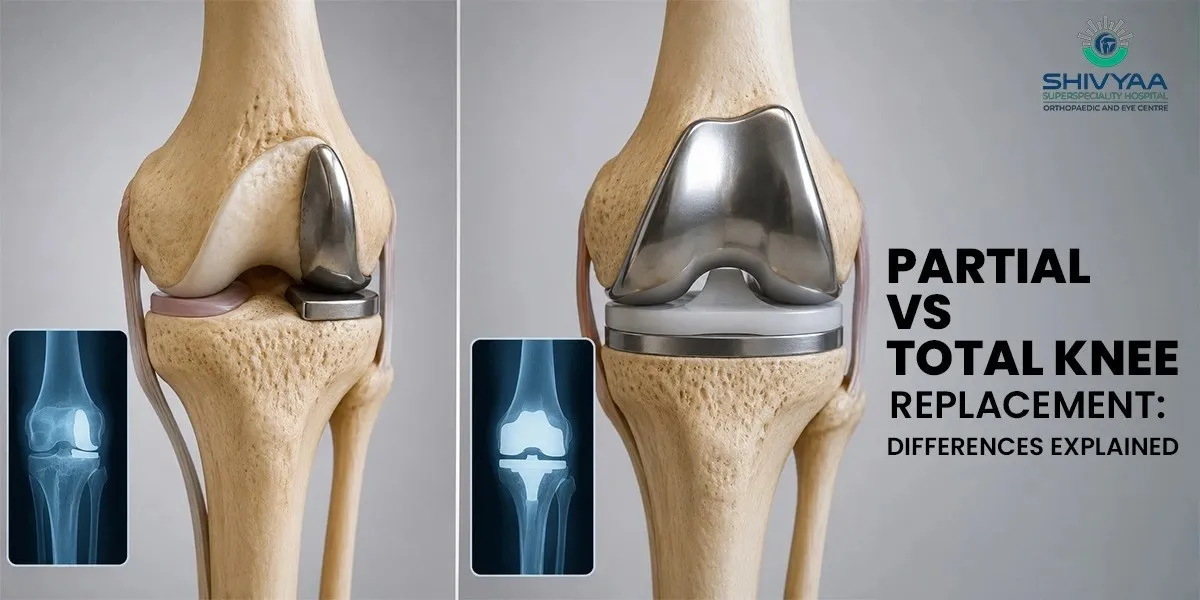
Your doctor says you need to get a knee replacement. Now you’re faced with a choice, and you don’t know the difference, so which is the better choice for you?
One of the most commonly asked questions orthopedic surgeons receive is, “Partial vs Total Knee Replacement? It’s a fair one. Both procedures are for treating knee pain due to arthritis or damage to the joint, but are different and have different recovery times and are appropriate for different patients.
The best part is, the decision doesn’t have to be daunting. With knowledge of what surgery entails and what it’s meant for, the way ahead appears quite clear.
This is a simple breakdown to help you understand both options before your consultation.
Understanding Knee Replacement Surgery
Persistent knee pain is debilitating. You take some tablets and miss your morning walk and then receive an injection and feel better for a few weeks, but the pain returns. One day, your doctor tells you the joint is the issue and not just the pain surrounding the joint.
That’s where knee replacement surgery will come in.
People who require this surgery have usually had arthritic symptoms for a long time. Others are suffering from rheumatoid arthritis. Others suffered severe damage to the knee at some stage, and the knee never healed properly. The common link is that there is a loss of cartilage, and no cartilage is available to support the joint adequately.
Surgically, there are two ways to solve the problem. A partial knee replacement involves the removal of the affected area of the knee, with the remaining components of the knee not being replaced. Recovery is usually more rapid, and the knee may feel more natural following surgery. In a complete knee replacement, the entire surface of the knee is replaced with an implant. It is also a larger procedure, but it is the proper choice if damage is throughout the entire knee.
Your surgeon will review both your scans and your symptoms to make one of the recommendations.
Pros and Cons of Partial Knee Replacement
For the right candidate, partial knee replacement offers real advantages worth considering.
Pros
- Minimal disruption of tissues and small incisions are made during surgery.
- Shorter stay in hospitals and faster recovery to normal activities.
- Less postoperative pain compared to total knee replacement.
- Maintains the natural knee structure more, providing a more natural sensation when moving
- Shorter overall rehab period
Cons
- Not suitable for everyone. It is most effective if confined to one compartment of the knee
- Must have good ligament stability to be a viable option
- May require revision surgery or conversion to total knee replacement at a later time should arthritis progression occur.
- Is subject to the normal surgical complications such as infection, blood clots, and wear of the implant over time
Pros and Cons of Total Knee Replacement
Total knee replacement offers results that partial knee surgery cannot in patients who have advanced or widespread damage to the knees.
Pros
- Super effective for relieving chronic knee pain throughout the knee.
- Most implants should last 15 to 20 years, if not more, with proper care.
- Suggested for deformity of large joints, multi-compartment damage, or severe arthritis.
- Successful long-term results and high patient satisfaction.
Cons
- Extended recovery time, with ongoing physiotherapy and rehab.
- The more surgery that needs to be performed, the more initial disruption to tissues
- It is expected that there will be swelling and stiffness during the recovery period
- May result in infection, blood clots, and, in rare cases, failure of the implant
Who Should Consider Partial Knee Replacement?
Partial knee replacement is most effective when the damage is confined. If arthritis has affected only one compartment of your knee and the rest of the joint is still in reasonable shape, this procedure could be the right fit.
Patients who tend to benefit most include the following:
- Those patients suffering from arthritis in one knee joint.
- Active individuals wanting to retain their natural mobility.
- Those with pain due to certain activities, such as climbing stairs.
- When patients suffer from specific forms of rheumatoid arthritis, and the damage is confined to
It is critical to understand that arthritis can be progressive. In the event that the condition becomes widespread to other areas of the knee joint, patients who have undergone partial joint replacement will require total knee replacement.
Who Should Consider Total Knee Replacement?
When the entire joint of the knee has been affected by arthritis and daily activities have become difficult, the next treatment option is knee replacement surgery.
It is suitable for:
- Patients who have extensive arthritis in multiple compartments of the knee
- People who suffer from rheumatoid arthritis or other autoimmune joint disorders
- People who haven’t had good relief from medicines, injections, physiotherapy, etc.
- Patients who have substantial deformity or instability of the knee
The total knee replacement is an extremely safe and proven technique and is indicated in patients in general, ranging from 35 to 98 years of age. The type of procedure that will be recommended by your doctor depends on your case.
How Do Partial and Total Knee Replacement Compare?
Feature | Partial Knee Replacement | Total Knee Replacement |
What is replaced | Damaged compartment only | Both sides, full joint surface |
Best suited for | Arthritis in one compartment, younger patients | Arthritis across the whole knee, age 35 to 98 |
Recovery | Walk faster, walk earlier | Pain reduces after day 15, normal by day 35, and fully recovered by day 90. |
Hospital stay | Shorter stay | Around 5 days with a home physio plan |
Physiotherapy | Compulsory | Compulsory for 30 days, the home team guides you |
Risk | May convert to total if arthritis spreads | Final solution, no conversion needed |
Sport after surgery | Cycling, golf, swimming, and tennis are all fine | Same activities; avoid squatting and kneeling |
Conclusion
Choosing between partial and total knee replacement is not a decision you should have to make alone or in a hurry. This will depend on the location of your damage, the extent of the damage, and your life following surgery. If carried out on the correct patient at the correct time, both surgeries can be highly effective.
The main thing is to get a proper assessment from a doctor who has taken the time to understand your situation and has not just given you a blanket answer. Dr. Parth Bhavsar has specialized in knee replacement surgery, arthroscopy, and complex joint care for 10 years at the Shivyaa Superspecialty Hospital, Gota, Ahmedabad. He treats every patient differently and looks at the whole picture, talks to the patient about all the options, and gives them a plan that is right for them in their lifestyle.
If you have been suffering from knee pain, then this is the time to find out what your knee is telling you.
Book a consultation with Dr. Parth Bhavsar at Shivyaa Superspeciality Hospital today.